by Richard Baxter DMD, MS | Apr 5, 2015 | Dental Health, Parent Questions, Treatment Options, Uncategorized
FAQ: What are sealants?
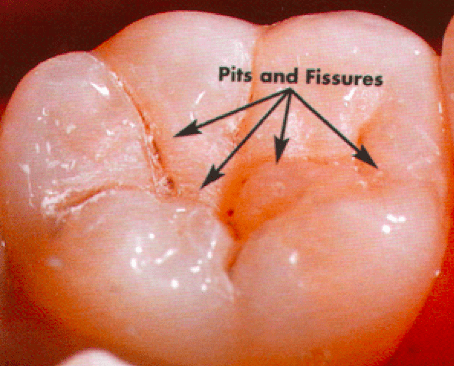
Sealants are a protective coating that can be placed in the deep grooves and pits of permanent molars (and sometimes other teeth). It is a white material that flows into the cleaned enamel, and when the blue light hits the sealant, it is cured and bonded to the tooth surface. Typically sealants can last 5-10 years, but sticky candy (jolly ranchers, laffy taffy, tootsie rolls, etc.) can pull them off, making them ineffective.
Sealants are important because around 42% of children aged 6-19 years have decay in their permanent teeth. Of those, 90% of cavities are found in the pits and fissures of the permanent molars. Sealants can reduce decay in children 86% at one year, 79% at two years, and up to 65% at nine years according to research from the ADA. Since we focus on prevention, we recommend sealants for all permanent molars, and we check the sealants at each visit to make sure they are doing their job of protecting the teeth. They are typically covered well by dental insurance, so they are a great way to protect your child’s teeth.
There was some concern in the past with BPA in dental sealants, and also with fluoride-releasing sealants. In our office, we use Clinpro from 3M ESPE, which contains no fluoride or BPA. Another factor unique to our office is the use of the Isolite system. Sealants placed with even slight moisture can fail quicker and will not protect the teeth as well as sealants placed in a dry field. The Isolite ensures that the child’s saliva is suctioned out during the entire procedure, and even reduces the humidity in the mouth to provide the best bonding and sealant retention possible. We can place the sealants in as little as 10 minutes on all four molars.
by Richard Baxter DMD, MS | Mar 24, 2015 | Dental Health, Parent Questions, Treatment Options, Uncategorized
FAQ: What are the different ways you can fix my child’s cavities?
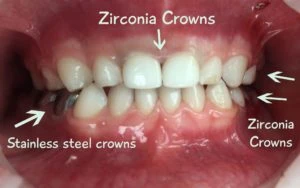
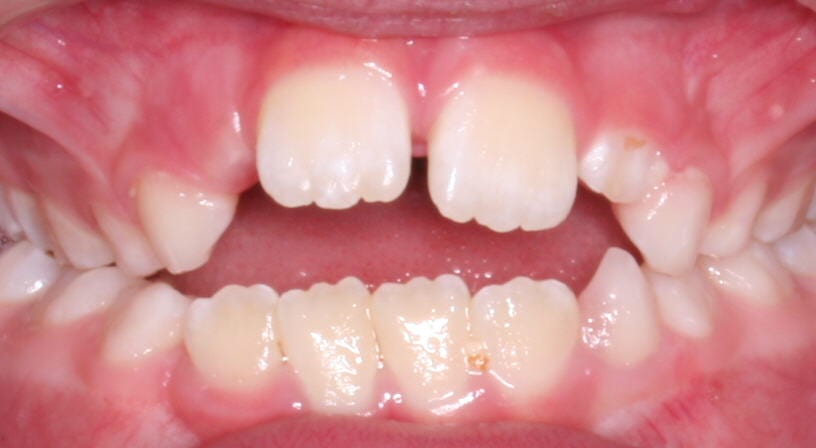
Actual picture of a patient treated by Dr. Baxter.
The treatment we use for children will depend on many different factors and can be quite complex. The two most important factors are the child’s age and their risk of future cavities. The treatment can range from simply monitoring or “watching” a cavity in a small child (or an older child who will lose the tooth soon) to having to do a silver cap in a child who has large decay on the tooth. The treatment of children’s teeth and more importantly, the child that those teeth are attached to, is much different than treatment for adults. We have to take into consideration the child’s psychological development, ability to cooperate in the chair, and their dietary and hygiene habits. In a nutshell, here are the different treatment options.
Monitor or watching a cavity: This is the most conservative route. There are many reasons we may recommend this option depending on the size and number of the cavities, the child’s age, the child’s brushing and flossing habits, and the child’s development.
White fillings: These plastic fillings are very common and are a good restoration to fix children’s teeth. We may recommend these to fix smaller cavities or to fix cavities in the grooves of the teeth. We don’t place any silver fillings (amalgams) because they contain mercury, which can be bad for your child and the environment.
Silver crowns or caps: These crowns are made of stainless steel (no mercury), and when the cavity grows bigger and has broken through to the sides of the tooth, or will require a baby tooth root canal (pulpotomy), then we will do a crown of some type. These silver crowns last longer than white fillings, and we know that the tooth is protected from getting any more cavities. If a child is younger, needs to have treatment in the surgery center, or has decay on many teeth (at a high risk), we may choose to use a crown to prevent further decay.
White crowns: This newer type of crown is made of zirconia and offer an esthetic option for teeth in the front or back of the mouth instead of silver crowns. These may be an option in a child that only needs a few crowns and is able to sit through the treatment (because they take longer to place than the silver ones). They are sometimes more costly than the silver crowns (depending on your insurance), but many parents like these because of their natural look.
Typically, treatment in the office is completed with nitrous oxide or laughing gas. This gas allows the child to relax, and within five minutes of turning it off, it is completely out of their system. Most children respond well to treatment in the office with laughing gas, and we can accomplish treatment that could otherwise not be done without it. It also reduces the gag reflex to increase your child’s comfort and produce the best dentistry possible.
If we are not able to complete treatment with nitrous oxide alone, then we may recommend oral sedation (for just a few teeth). If the child has more extensive dental needs, has had a fearful experience in the past, has special needs, or has lots of anxiety, we may recommend general anesthesia at Children’s Hospital with pediatric anesthesiologists.
With any decision to treat your child, we always weigh several options to individualize the choice to your child (because all children are different) and we strive to treat your child as we would our own. I only recommend treatment that I would do if it were my daughter in that situation, and when there is a choice between two good options, we let the parents know the options and let them decide.
If you have any questions about this post, or any others, please contact Dr. Baxter or the team at 205-419-7444.
by Richard Baxter DMD, MS | Mar 8, 2015 | Bad Habits
FAQ: Is it ok if my child still sucks their thumb or pacifier?
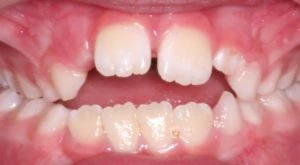
Thumb sucking and pacifier sucking is very common in young children because so many babies use these methods to self-soothe beginning at birth. Sometimes, babies can be seen sucking their thumb in the womb, (like our daughter Hannah). Often, babies fall asleep with pacifiers for nighttime or naps, and it can be very difficult to break this habit due to crying and sleepless nights.
However, it is critical that these habits are addressed before the age of three. Most studies show that if the child can quit using a pacifier or sucking their thumb before age three, there shouldn’t be too many long-term effects. The good news is that most children quit on their own between age 2 and 4. Of course, the frequency and intensity of the sucking habit can cause damage to the teeth and jaws by age three (if they are using it all day, sucking very hard, etc.). These sucking habits can cause changes to the growth and development of the teeth, and even the shape of the face.
There are several methods to encourage children to stop pacifier sucking or thumb sucking, but whatever method you choose, it will be a challenge. There are some helpful blogs and other websites to help with creative ideas for stopping sucking habits. You can have a party for your child after thirty days of being pacifier or thumb sucking free. You can take the pacifier to a toy store and have your child “buy” the toy by giving the pacifier to the cashier to “pay for it” (after you of course paid for it already!). If these options don’t work for a thumb sucking habit, before trying an appliance that could be placed in the mouth, the next step would be to try a bitter, clear nail polish called Mavala Stop. It works very well if used appropriately, not on children under three, and used consistently for about 40 days. It is used as a reminder to the child to not suck their thumb, NOT as a punishment. We see good results with this method when others have failed, so if you have a thumb sucker at home, order some online, or get some when you’re at the office. If you have any other questions, or if you would like to schedule an appointment, please call us at 205-419-7444.
by Richard Baxter DMD, MS | Feb 27, 2015 | Cavities, Dental Health, Infant oral health, Parent Questions, Pediatric Dentistry
FAQ: How Does My Child Get Cavities?
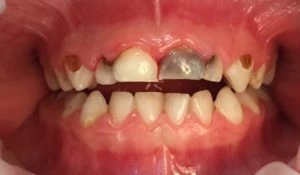
Cavities
The two ways that your child can get cavities are by not brushing (or flossing) his or her teeth, and by consuming too much sugar. Sugar can be in many forms, either liquid (milk, juice, or other sugary drinks) or solid (sweets and candy). Typically the liquid form of sugar can cause cavities quicker in children. Often when we see decay in a young child, they have had access to a bottle or sippy cup whenever they want it, or they drink from a bottle at nighttime with milk in it. Milk contains a natural sugar, lactose, which can be changed into an acid by the bacteria in the mouth and cause cavities when it sits on the child’s teeth. Juice, chocolate milk, sweet tea, or even Coca Cola are often given to children to drink. These all contain similar amounts of sugar and can cause tooth decay extremely rapidly. (Side note: Juice contains more sugar than Coca Cola!) If this process of changing sugars from the diet into lactic acid by the bacteria in the mouth happens often over time, the enamel will begin to weaken. The rate of cavity formation is based on the frequency of sugar intake. If the tooth is exposed to sugar (and therefore acid) more frequently, the enamel will dissolve faster, and cavities will form rapidly. So the best time for a child to drink a beverage containing sugar (even milk) is just with meals, rather than throughout the day. At night, if a child has milk or juice, it stays on the teeth for a very long time, and there is not much saliva produced at night to wash it off the teeth. Therefore, children should only drink water at night and should drink water throughout the day as much as possible.
The frequency of sugar consumed is only one piece of the puzzle. We also need to have high amounts of bacteria that can convert the sugar to acid. The main way we can reduce the bacteria in the mouth is by brushing and flossing. It’s important to start brushing a child’s teeth as soon as they enter the mouth, typically around six months. You can begin using a fluoride toothpaste (which makes the enamel stronger and harder to dissolve) as soon as you start brushing by using a smear of toothpaste. As soon as teeth begin to touch, most often where the back molars meet or where the two front teeth meet, it’s a good idea to start flossing. You can use little flossers with handles, and wipe the piece of floss off after going between each set of teeth.
The final piece of the puzzle is the part that you cannot really change. Your child will get bacteria in their mouth that can cause cavities (typically from mom, but sometimes from dad or another relative). So it’s important for everyone around the baby to have excellent oral health to minimize the bacteria transferred when you kiss your baby, they try your food, or any other activities where saliva may be transferred from parent to baby. However, you cannot change the genetics that influence the hardness of the teeth. Some people’s teeth are a little softer (and more likely to get cavities), and we don’t yet know why. BUT the important thing to realize is that if you or your spouse have “bad teeth” or if you have a history of “soft teeth” in the family, be sure to be extra careful with sugar in the child’s diet and be extra careful to brush your child’s teeth very well, twice a day. Even if the child has “softer teeth”, he or she can still be cavity free with good brushing and limiting sugar intake.
If you have any other questions about cavities in young children, we would be happy to answer them for you. Call our office at 205-419-7444.
by Richard Baxter DMD, MS | Feb 18, 2015 | Dental Health, Infant oral health, Parent Questions, Pediatric Dentistry
Frequently Asked Question: When should my child first go to the dentist?
FirstDentalVisit
The old answer was to see the dentist by age three. This recommendation was because most dentists who see kids are general dentists who did not want to see small, crying, uncooperative children, nor were their offices equipped to see small children. Most general dentists (family dentists) are doing crowns, dentures, fillings, and seeing anyone from age 3 to 100. Recently, pediatric dentists have changed the recommended first age to “First Visit by the First Birthday”. This change was in response to us seeing so many children at age three (the traditional first visit) who already had severe decay. Typically this was due to taking a bottle at night and not brushing the teeth due to a lack of education. We have seen countless children in our six months of being open who already have a mouthful of cavities by the time we first see them at age three. So we agree with the AAPD and ADA which recommend the first visit by age 1. Pediatric Dentists (like Dr. Baxter) receive special training in residency to examine and work with small children under age three.
What do we do at our age one visit? We will focus on prevention and education of the parent. This educational component is the most important part of the visit (not the actual tooth cleaning). We will discuss dietary habits, drinking with a bottle or sippy cup, any thumb sucking or pacifier habits, and review brushing habits. We will typically do a knee to knee exam (lap exam) and cleaning with children age 3 and under. This is where the child lays in the parent’s lap and leans back into the hygienist or dentist’s lap to clean and examine the teeth more easily. This is less threatening to a child than getting in a chair. Sometimes children will jump up on our benches (which don’t move) because they are used to getting on the exam table at the pediatrician’s office. If they jump up there, we will brush their teeth on our regular benches if they are comfortable. We try to make the visit as easy and comfortable for both child and parent as possible, but even still, most children do cry (some more than others!). Sometimes the children do cry and scream, but in a pediatric office we are used to this behavior and it doesn’t disrupt our office like it would a more cosmetic focused, general dentistry office. We will brush their teeth with a gentle toothbrush and examine the teeth and gums for any cavities or anything that doesn’t look normal. The last step is to paint the fluoride varnish, which is a sticky fluoride that will protect the teeth and make them stronger.
If you have any questions about oral health for infants and young children, please give us a call, or if you would like to set up an appointment, you can call us at 205-419-7444.