by Richard Baxter DMD, MS | May 16, 2017 | Dental Health, Infant oral health, Pediatric Dentistry
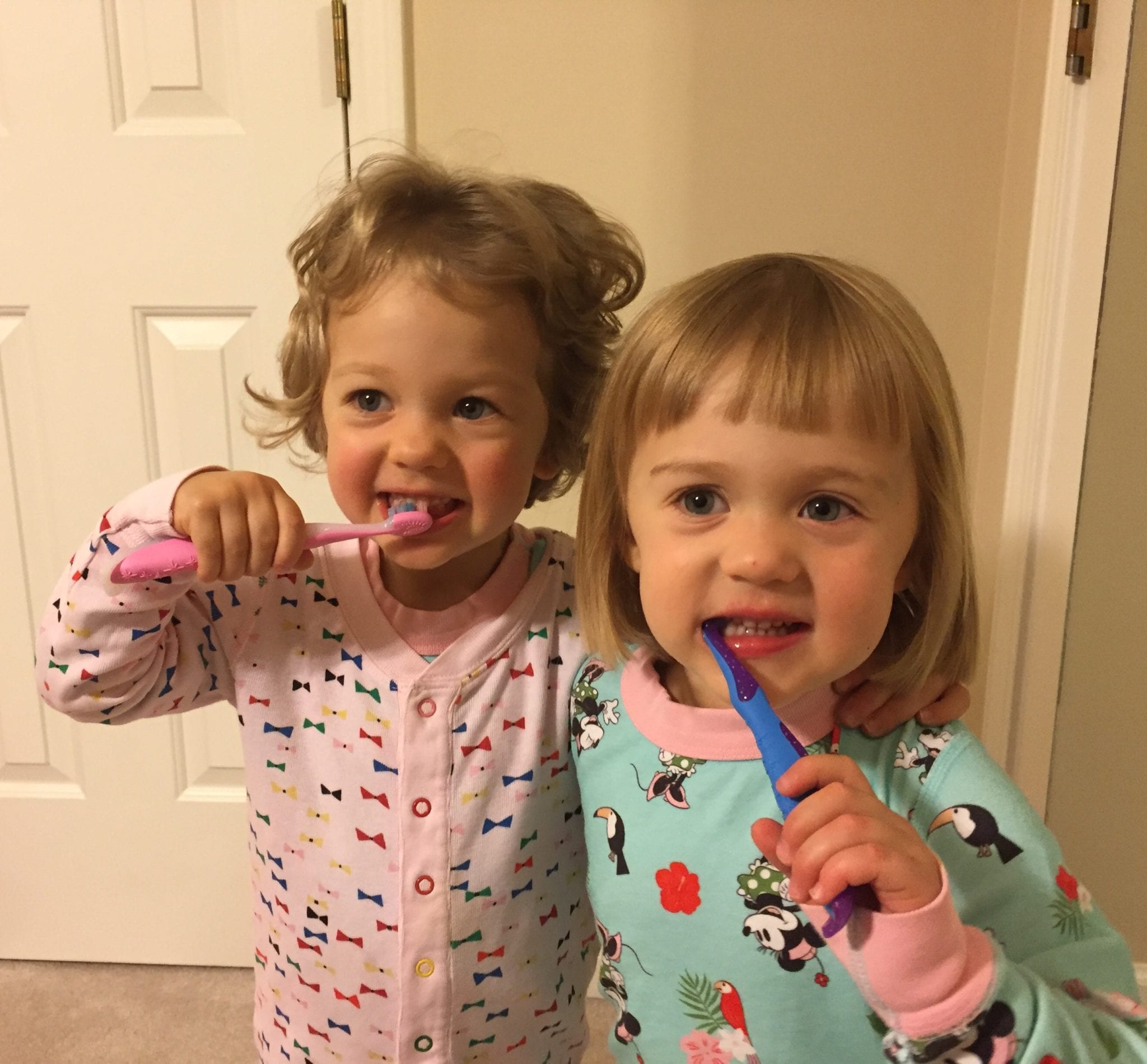
Many parents might find themselves wondering why we make all this fuss about baby teeth. They’re going to fall out anyway, right? It is true that the baby teeth will fall out eventually. The trouble is, some of those teeth are still in the mouth for a long time. Did you know that on average, the final baby teeth to fall out (the upper canines) aren’t lost until age 12! 
If a tooth has an infection, like cavities, or has experienced trauma, it is often recommended to treat the infection or condition in order to restore the tooth to optimal function and esthetics. This is true of a baby tooth or a permanent tooth. There are many reasons to treat baby teeth just like we would permanent teeth. Below we’ll discuss just a few.
First, baby teeth are important for a child’s self-esteem. Children are sensitive to the appearance of their smiles just like adults are – we all want to have beautiful teeth to show the world. Second, baby teeth are important for functions like speech and chewing. If any of the teeth are broken down or causing pain, chewing and speaking can be impacted and lead to negative developmental consequences. Thirdly, baby teeth are important to the overall growth and development process of the jaw. Baby teeth act as space-holders for the permanent teeth that will eventually take their place, so if a baby tooth is lost early due to disease or trauma, permanent tooth positioning and jaw development can be negatively impacted as well. Last but certainly not least, it is important to keep your child’s baby teeth healthy and functional so that your child is comfortable and pain-free. Many children with dental disease have trouble concentrating in school and they miss more school days than children with healthy teeth, so routine checkups and following through with treatment recommendations are vital to making sure your child’s teeth are healthy and your child is able to go through their day to day life comfortably.
We hope this short post has helped you see the importance of your child’s baby teeth! Be sure to brush them twice a day with fluoridated toothpaste, floss in-between them daily, limit sugar in the diet (juice and fruit snacks included!), and visit your dentist for checkups every 6 months!
This post was written by Dr. Taylor McFarland, our board-certified pediatric dentist. If you have any questions about baby teeth or any other dental topics, please call our office at 205-419-7444 or send us an email at info@shelbypediatric.com.
by Richard Baxter DMD, MS | Jul 2, 2016 | Infant oral health, Pediatric Dentistry, Uncategorized
Why did we get a new laser? We had been using the iLase dental laser from Biolase. It’s a pen-like device that belongs to a subset
of lasers called “diode” lasers. How it works is the tip is “initiated” by something like cork or blue paper before each use, which then focuses the laser energy at the tip of the laser during use and makes it very hot. The laser is then used to remove the tissue by essentially searing it off or cauterizing it. The laser has beneficial properties for tissues like “photobiomodulation” and other fancy terms, but for the most part, it’s a very hot tip. This style of laser (diode) is the most commonly used laser in dentistry, and it works well for many soft tissue procedures, but it takes a long time.
However, in the quest for the best all-around laser for our patients, I came across CO2, Er:YAG, and Er,Cr:YSGG. We went with CO2 because it acts differently than the other lasers. A diode laser is a white-hot tip that sears the tissue, whereas the Erbium and CO2 lasers work by vaporizing the water in the cells (which means much less of the “burning” smell that was present with the diode laser). Weighing all the options, I felt that the laser with the least intraoperative and postoperative pain, quickest procedure time, minimal to no bleeding, and fastest healing was the CO2 laser. Ours is sold by LightScalpel.
The procedure with the LightScalpel is about 10-20 seconds for the upper lip and about 10-20 seconds for the tongue. With the diode, sometimes it would take 60-120 seconds for the upper lip and 60 seconds for the tongue. When performing these procedures, we allow the parents back (or they can choose to remain in the consult room), and many times that is the longest 5 minutes of a parent’s life! If we can decrease the time it takes for the procedure, the better it is for the clinical team, the parent, and of course, the child.
So what does this mean in English? This means less discomfort for the baby or child with a lip or tongue tie during and after the procedure and a quicker procedure in the office.
For these reasons and more, although the CO2 laser is significantly more expensive, I believe it’s a great investment for our practice and especially for our littlest patients. We are one of the only offices in Alabama with a CO2 laser and the only office in Alabama using a CO2 laser for infants, children, and teens with tongue and lip ties. Please call our office if you have any questions about this post or would like to schedule an appointment. 205-419-7444.
by Richard Baxter DMD, MS | Sep 17, 2015 | Infant oral health, Parent Questions

Knee2Knee
FAQ: How should I brush my child’s teeth?
Brushing your child’s teeth changes as they get older. It’s important to start brushing your child’s teeth at 6 months, or as soon as the first tooth comes in. Make sure to use just a smear of fluoride toothpaste for children age 6mo to 2 years, and a pea size amount for children age 2yrs and older. The easiest way to brush a toddler’s teeth who doesn’t want to cooperate is to lay them on the ground and place their head between your legs and their arms stretched out under your legs (see photo). This allows you to use one hand to lift the lips and the other to brush the teeth without the child interfering with the brushing process. Typically, uncooperative children will only require this position for a week or two, then will realize that brushing will happen regardless of their desire to brush or not. Hopefully, they will allow you to brush their teeth while they are sitting up normally. If you have two people, you can use the “knee-to-knee” position like we use in the office. Have the two caregivers face each other with one holding the child. Parent #1 will wrap the child’s legs around their waist and lean them back into the other parent’s lap. Parent #2 will then brush the teeth while parent #1 holds the child’s hands gently.
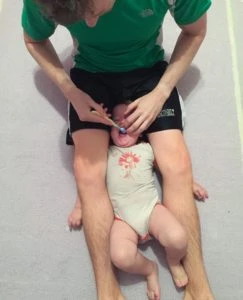
Brushing Position
Once your children get used to brushing daily, then you stand behind the child for an easier angle and brush their teeth in the bathroom. You can also try brushing their teeth while watching TV if they watch a show at night, or using some other distraction like an engaging toy. Once the child is age 2-9, you can allow them to try to brush their teeth first, and then the parent should brush afterward. Pay special attention to the gumline and the back teeth. Often, you will have to lift the child’s upper lip or lower the bottom lip to be able to brush effectively.
Once the child is around age 10 (some may be ready for independent brushing a little sooner or a little later) then allow the child to brush on their own, but it’s still important to at least check their teeth every few days to make sure they are brushing effectively. If the teeth look orange, or look dull (not shiny) or are “fuzzy”, then there is too much plaque on the teeth. You may need to help your child hit the problem areas and go back to checking the teeth daily.
Hopefully this information will help you and your child to brush well at all ages. If you have any questions, please ask one of our hygienists during your visit, ask Dr. Baxter, or call the office at 205-419-7444.
by Richard Baxter DMD, MS | Feb 27, 2015 | Cavities, Dental Health, Infant oral health, Parent Questions, Pediatric Dentistry
FAQ: How Does My Child Get Cavities?
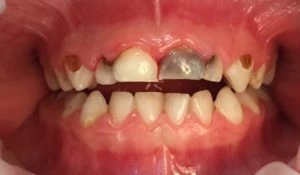
Cavities
The two ways that your child can get cavities are by not brushing (or flossing) his or her teeth, and by consuming too much sugar. Sugar can be in many forms, either liquid (milk, juice, or other sugary drinks) or solid (sweets and candy). Typically the liquid form of sugar can cause cavities quicker in children. Often when we see decay in a young child, they have had access to a bottle or sippy cup whenever they want it, or they drink from a bottle at nighttime with milk in it. Milk contains a natural sugar, lactose, which can be changed into an acid by the bacteria in the mouth and cause cavities when it sits on the child’s teeth. Juice, chocolate milk, sweet tea, or even Coca Cola are often given to children to drink. These all contain similar amounts of sugar and can cause tooth decay extremely rapidly. (Side note: Juice contains more sugar than Coca Cola!) If this process of changing sugars from the diet into lactic acid by the bacteria in the mouth happens often over time, the enamel will begin to weaken. The rate of cavity formation is based on the frequency of sugar intake. If the tooth is exposed to sugar (and therefore acid) more frequently, the enamel will dissolve faster, and cavities will form rapidly. So the best time for a child to drink a beverage containing sugar (even milk) is just with meals, rather than throughout the day. At night, if a child has milk or juice, it stays on the teeth for a very long time, and there is not much saliva produced at night to wash it off the teeth. Therefore, children should only drink water at night and should drink water throughout the day as much as possible.
The frequency of sugar consumed is only one piece of the puzzle. We also need to have high amounts of bacteria that can convert the sugar to acid. The main way we can reduce the bacteria in the mouth is by brushing and flossing. It’s important to start brushing a child’s teeth as soon as they enter the mouth, typically around six months. You can begin using a fluoride toothpaste (which makes the enamel stronger and harder to dissolve) as soon as you start brushing by using a smear of toothpaste. As soon as teeth begin to touch, most often where the back molars meet or where the two front teeth meet, it’s a good idea to start flossing. You can use little flossers with handles, and wipe the piece of floss off after going between each set of teeth.
The final piece of the puzzle is the part that you cannot really change. Your child will get bacteria in their mouth that can cause cavities (typically from mom, but sometimes from dad or another relative). So it’s important for everyone around the baby to have excellent oral health to minimize the bacteria transferred when you kiss your baby, they try your food, or any other activities where saliva may be transferred from parent to baby. However, you cannot change the genetics that influence the hardness of the teeth. Some people’s teeth are a little softer (and more likely to get cavities), and we don’t yet know why. BUT the important thing to realize is that if you or your spouse have “bad teeth” or if you have a history of “soft teeth” in the family, be sure to be extra careful with sugar in the child’s diet and be extra careful to brush your child’s teeth very well, twice a day. Even if the child has “softer teeth”, he or she can still be cavity free with good brushing and limiting sugar intake.
If you have any other questions about cavities in young children, we would be happy to answer them for you. Call our office at 205-419-7444.
by Richard Baxter DMD, MS | Feb 18, 2015 | Dental Health, Infant oral health, Parent Questions, Pediatric Dentistry
Frequently Asked Question: When should my child first go to the dentist?
FirstDentalVisit
The old answer was to see the dentist by age three. This recommendation was because most dentists who see kids are general dentists who did not want to see small, crying, uncooperative children, nor were their offices equipped to see small children. Most general dentists (family dentists) are doing crowns, dentures, fillings, and seeing anyone from age 3 to 100. Recently, pediatric dentists have changed the recommended first age to “First Visit by the First Birthday”. This change was in response to us seeing so many children at age three (the traditional first visit) who already had severe decay. Typically this was due to taking a bottle at night and not brushing the teeth due to a lack of education. We have seen countless children in our six months of being open who already have a mouthful of cavities by the time we first see them at age three. So we agree with the AAPD and ADA which recommend the first visit by age 1. Pediatric Dentists (like Dr. Baxter) receive special training in residency to examine and work with small children under age three.
What do we do at our age one visit? We will focus on prevention and education of the parent. This educational component is the most important part of the visit (not the actual tooth cleaning). We will discuss dietary habits, drinking with a bottle or sippy cup, any thumb sucking or pacifier habits, and review brushing habits. We will typically do a knee to knee exam (lap exam) and cleaning with children age 3 and under. This is where the child lays in the parent’s lap and leans back into the hygienist or dentist’s lap to clean and examine the teeth more easily. This is less threatening to a child than getting in a chair. Sometimes children will jump up on our benches (which don’t move) because they are used to getting on the exam table at the pediatrician’s office. If they jump up there, we will brush their teeth on our regular benches if they are comfortable. We try to make the visit as easy and comfortable for both child and parent as possible, but even still, most children do cry (some more than others!). Sometimes the children do cry and scream, but in a pediatric office we are used to this behavior and it doesn’t disrupt our office like it would a more cosmetic focused, general dentistry office. We will brush their teeth with a gentle toothbrush and examine the teeth and gums for any cavities or anything that doesn’t look normal. The last step is to paint the fluoride varnish, which is a sticky fluoride that will protect the teeth and make them stronger.
If you have any questions about oral health for infants and young children, please give us a call, or if you would like to set up an appointment, you can call us at 205-419-7444.